


Blog Posts
How Google Maps Ranking Brings High-Intent Dental Patients
Introduction
When people need a dentist today, most do not open a directory or wait for recommendations. They search on Google. Searches like “Dentist near me,” “Dental clinic in Kochi,” and “Best orthodontist nearby” have become part of normal patient behavior. And where do patients click first? Usually the Google Maps results. This is why Google Maps ranking has become one of the most powerful patient acquisition channels for dental clinics in India. Clinics that appear in the top local results often receive significantly more calls, website visits, direction requests, and appointment inquiries. The important part is this: these are not random visitors. These are high-intent patients actively looking for treatment.
Table of Contents
- Why Google Maps Matters for Dentists
- Understanding High-Intent Patient Searches
- How Google Decides Local Rankings
- The Biggest Google Maps Mistakes Clinics Make
- Why Reviews Matter More Than Ever
- The Role of Local SEO in Dental Growth
- Real-World Clinic Comparison
- Building Long-Term Google Visibility
- Conclusion
- FAQ
- CTA
Why Google Maps Matters for Dentists
Google Maps is no longer just a navigation tool. It has become a patient decision-making platform.
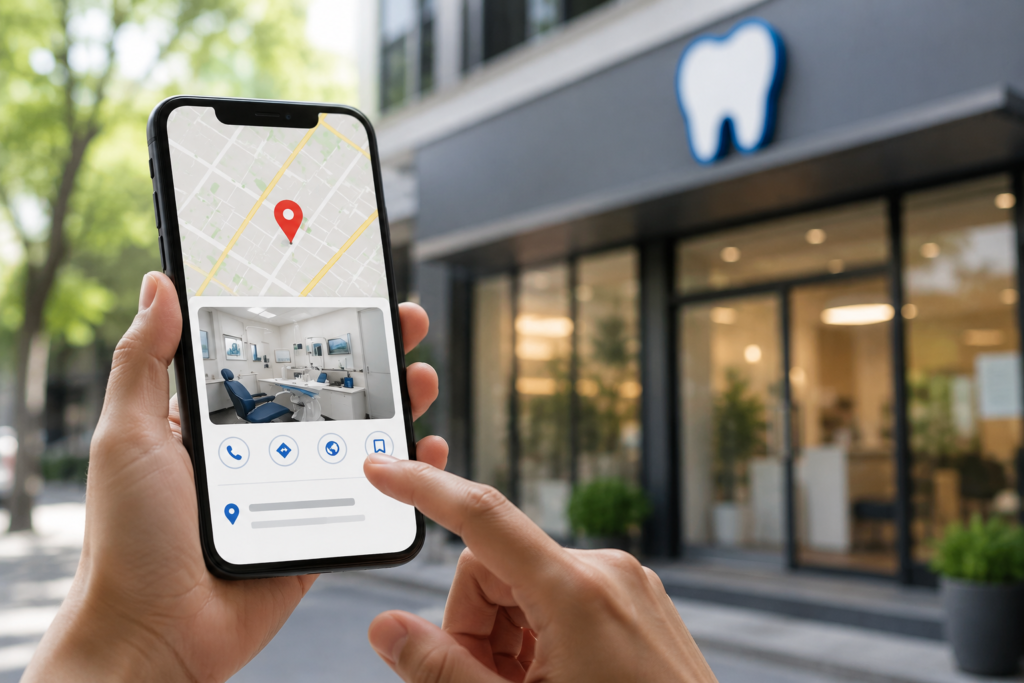
When someone searches for dental treatments, Google often shows clinic names, ratings, reviews, photos, directions, and phone numbers before even showing websites. This means patients often form their first impression directly from Google Maps.
A clinic with strong reviews, high visibility, updated photos, and accurate information immediately gains more trust.
Understanding High-Intent Patient Searches
Not all online traffic is equal. Someone casually watching an Instagram reel may not need treatment immediately.
However, someone searching for “Root canal specialist near me,” “Emergency dentist open now,” or “Dental implant clinic Kochi” already has intent. These patients are closer to booking an appointment because they are actively searching for a solution.
That is why local SEO and Google Maps visibility often produce better patient quality than random social media reach.
How Google Decides Local Rankings
Google mainly looks at three factors: relevance, distance, and authority.
Relevance refers to how closely your clinic matches the patient’s search. For example, a clinic optimized for Invisalign treatment has a better chance of appearing for aligner-related searches.
Distance refers to how close the clinic is to the searcher. This is why local optimization matters at both city and area levels.
Authority refers to how trustworthy and established your clinic appears online. Authority is built through reviews, website SEO, consistent business information, patient engagement, and local citations.
How Google Decides Local Rankings
Google mainly looks at three factors: relevance, distance, and authority.
Relevance refers to how closely your clinic matches the patient’s search. For example, a clinic optimized for Invisalign treatment has a better chance of appearing for aligner-related searches.
Distance refers to how close the clinic is to the searcher. This is why local optimization matters at both city and area levels.
Authority refers to how trustworthy and established your clinic appears online. Authority is built through reviews, website SEO, consistent business information, patient engagement, and local citations.
The Biggest Google Maps Mistakes Clinics Make
One of the most common mistakes is having an incomplete Google Business Profile. Many clinics leave categories incomplete, fail to add services, ignore photos, and rarely post updates. An incomplete profile weakens visibility and reduces opportunities to appear in local search results.
Another major issue is a poor review strategy. Some clinics provide excellent treatment but have very few reviews. Patients rely heavily on visible social proof when choosing a healthcare provider. A clinic with hundreds of quality reviews often gains more trust instantly than a clinic with only a handful of reviews.
Many clinics also overlook website SEO. Google Maps rankings are strongly connected to website authority. If a clinic’s website has poor SEO, weak content, slow loading speed, or lacks dedicated treatment pages, local rankings can suffer as well.
Inconsistent business information is another common problem. Different phone numbers, addresses, or business details across various platforms can create confusion for Google and weaken trust signals.
Finally, many clinics ignore patient experience. Google increasingly values real user engagement. When patients leave reviews, click for directions, spend time on a website, and interact with a business listing, Google interprets these actions as signs of trust and relevance.
Why Reviews Matter More Than Ever
Reviews are no longer optional. They influence rankings, trust, conversions, and patient decisions.
When patients compare dental clinics, they often evaluate rating quality, the number of reviews, and recent patient experiences before making contact. Even excellent SEO can struggle to generate results if trust signals are weak.
The best review strategy is ethical and experience-driven. Clinics that consistently deliver positive patient experiences naturally encourage more patients to leave genuine reviews, strengthening both credibility and visibility.
The Role of Local SEO in Dental Growth
Local SEO helps clinics appear when nearby patients search for treatments and dental services.
This includes optimizing a Google Business Profile, targeting location-based keywords, creating treatment-specific pages, managing reviews, and building local authority online.
For dentists, local SEO is not simply about increasing website traffic. It is about attracting nearby patients who are actively searching for dental care and are more likely to schedule appointments.
A Real-World Clinic Comparison
Consider two clinics offering similar treatment quality.
Clinic A has a skilled dentist but limited reviews, a weak Google profile, and minimal website SEO. Clinic B has an optimized Google Business Profile, a strong review system, treatment-focused SEO pages, and consistent online visibility.
Although both clinics may provide excellent treatment, Clinic B typically receives more inquiries because patients discover it more easily and trust it faster. Visibility creates opportunities, while trust drives conversions.
Building Long-Term Google Visibility
Strong Google Maps rankings do not happen overnight. They are built through consistency and ongoing effort.
Clinics that steadily grow through Google usually focus on maintaining an SEO-friendly website, generating reviews, publishing consistent updates, creating local content, improving treatment visibility, and strengthening patient trust signals.
Over time, these efforts create a sustainable flow of patients without relying entirely on referrals or paid advertising.
Conclusion
Google Maps has become one of the most important growth platforms for dental clinics in India.
Modern patients search online before making healthcare decisions. The clinics that appear prominently in local search results often gain more trust, receive more inquiries, attract better patient flow, and experience stronger long-term growth.
Dental marketing today is not simply about promotion. It is about being visible at the exact moment patients are searching for treatment.
Want your dental clinic to rank higher on Google Maps and attract more high-intent patients?
Rabboni Digital Marketing helps dental clinics improve Google visibility through local SEO, Google Business Profile optimization, website SEO, review strategies, and patient acquisition systems.
F.A.Q.
Because most patients search online before choosing a dentist, and Google Maps often appears before websites in local searches.
By optimizing Google Business Profile, improving reviews, strengthening website SEO, and maintaining consistent local information.
Yes. Reviews strongly influence both patient trust and Google visibility.
For high-intent searches, Google Maps usually produces stronger patient inquiries because users are actively searching for treatment.
Local SEO is a long-term strategy. Consistent optimization typically shows stronger results over several months.
