


Blog Posts
SEO vs GEO : 5 Similarities and Differences Every Digital Marketer Should Know
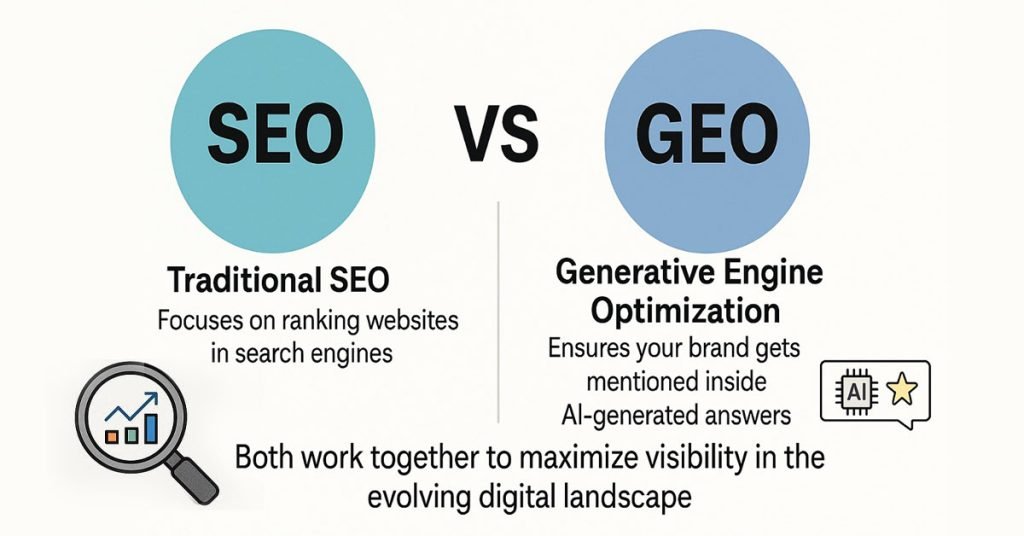
The method in which people search online is rapidly evolving. For a long time, Search Engine Optimization (SEO) has been at the core of digital marketing, based on improving your presence on the first page of Google and other search engines. With the new generation of AI-powered search engines and generative models, there is a new term entering the nomenclature of the industry: Generative Engine Optimization (GEO).
GEO’s intention is to enhance your brand, content, and data’s visibility in AI-driven answers, rather than just visibility on the search engine results pages (SERPs). SEO and GEO share some similar principles, but they are distinct in how they are enacted, marketers need to grasp both.
Table of Contents
- What is SEO?
- What is GEO (Generative Engine Optimization)?
- 5 Key Differences Between SEO and GEO
- 5 Key Similarities Between SEO and GEO
- Why Marketers Need Both
- Conclusion
- FAQs
1. What is SEO?
SEO, or search engine optimization, is the act of optimizing your site so that it ranks higher in search results from sites like Google, Bing, etc. The objective is to get users to click your link and arrive at your site.
How search engines operate
- Crawling: Bots scour the internet, following links and collecting a page’s data.
- Indexing: The pages collected are indexed, which entails retrieving the data collected and analyzing it before being stored in a massive library (index).
- Ranking: The algorithm sorts the indexed pages based on relevance, and the results are displayed in the SERPs.
SEO strategies
- Keyword research → to find out which terms your audience is searching for.
- On-page SEO → create content that answers search intent.
- Off-page SEO → get backlinks from sites that are vetted and trustworthy.
- Technical SEO → ensure your site is fast, mobile friendly, and crawlers can crawl your site.
Long story short: you can get high traffic volume (organic) and brand visibility through clicks.
2. What is GEO (Generative Engine Optimization)?
GEO (Generative Engine Optimization), or sometimes referred to as AEO (Answer Engine Optimization) or LLMO (Large Language Model Optimization), is the act of having your brand referenced, cited, and accurately identified in AI-generated answers from ChatGPT, Google AI Overviews, Perplexity, and Gemini.
Note that the difference between traditional SEO and GEO is that the goal here is not simply getting clicks; but the average person seeing your brand cited in an AI answer.
How AI search works
- No browsing: Answers are generated from the information the model has been trained on (and may be outdated).
- With browsing: AI summarizes new information from web pages and cites the sources.
Key GEO Strategies
- Third-party mentions → Get listed on review sites, “best of” lists, and discussion forums like Reddit.
- AI-friendly content → How-to guides, comparisons, studies with data, FAQs, etc.
- Facts and statistics → Publish your own verifiable data and statistics that AI can cite.
- Multi-platform → YouTube and Reddit are often cited in AI Overviews.
- Structured information → Using schema, Q&A, bullet points to structure content.
- Fresh content → Page freshness is a consideration for how frequently or recently the content is updated.
3. 5 Key Differences Between SEO and GEO
Aspect | SEO | GEO (Generative Engine Optimization) |
Goal | Get clicks to your site | Get mentioned in AI answers |
Where you appear | Blue links in SERPs | Inside AI summaries and responses |
Primary source | Your website pages | Third-party mentions (reviews, PR, forums) |
Traffic impact | Brings large volumes of visitors | Brings fewer, but highly intent-driven visitors |
Success metrics | Rankings, backlinks, organic traffic | Mentions, citations, AI share of voice, AI referrals |
Example:
In SEO: A user searches for “Paid marketing in Kochi.” Google shows a list of paid marketing agencies like Rabboni Digital Marketing, Designsages, Adox Global, etc., on the first page. The user clicks on one of these websites to get more details. SEO drives website traffic through search results.
In GEO: if a user asks, “Paid marketing in Kochi,” the focus is on AI mentions and visibility rather than clicks. Agencies are ranked based on their presence in AI knowledge, reviews, forums, and structured data. Success is measured by AI citations, share of voice, and relevance in generative answers.
4. 5 Key Similarities Between SEO and GEO
- Understanding user intent is important → Both seek to fulfill what individuals are sincerely searching for.
- Quality content is paramount → Helpful, reliable, authoritative content is a differentiator in both.
- Reputation & trust matter → EEAT signals + brand authority help rankings.
- Technical set up matters → Structured data and crawlability help both SEO and GEO.
- They build visibility → Both are strategies to help build a long-term brand awareness.
5. Why Marketers Need Both
SEO is your foundation. It generates most web traffic, builds brand authority, and feeds AI with structured, trustable data.
GEO is your emergent strategy. It assures your brand is visible in AI-driven zero-click answers, where users increasingly rely for rapid, on-the-go decisions.
Together, SEO + GEO = visibility in old search and new AI-search.
Conclusion
GEO and SEO do not compete, they complement each other. When it comes to traffic, you want SEO to bring it to you. When it comes to mentions, you want GEO. SEO provides broad visibility, while GEO is how you surround your brand within AI responses where trust and authority are most important.
Digital marketing agencies in Kochi, who are on the leading edge of this forward-thinking marketing strategy will keep brands in the public eye and as an authority, no matter how search is changing.
Ready for the future of search?
We help brands optimize for both SEO and GEO, ensuring visibility in Google and AI search engines.
F.A.Q.
No. GEO complements SEO. Traditional search is still vital, but AI-driven answers are growing fast.
Focus on structured, authoritative, frequently updated content and aim to get cited by third-party sites.
Monitor AI citations, mentions inside ChatGPT/Perplexity, and “AI share of voice” with new analytics tools
Author

Rabboni Digital Marketing, a leading digital marketing company in Kochi, Kerala, empowers businesses to unlock their online potential. We offer a comprehensive suite of services including social media marketing, Google and YouTube advertising, content marketing, and SEO, all tailored to your specific needs.
